
$4 Billion, 23 Vendors, Zero African Winners: Africa's Daily Bulletin for 3 November 2026
On 21 October, 23 vendors met in Johannesburg for South Africa's DiBETSA awards. AfDB and Islamic Development Bank say they've approved 66% of a $4 billion Africa financing target. Bentley's global infrastructure awards, meanwhile, again list zero African winners. Four sourced stories.

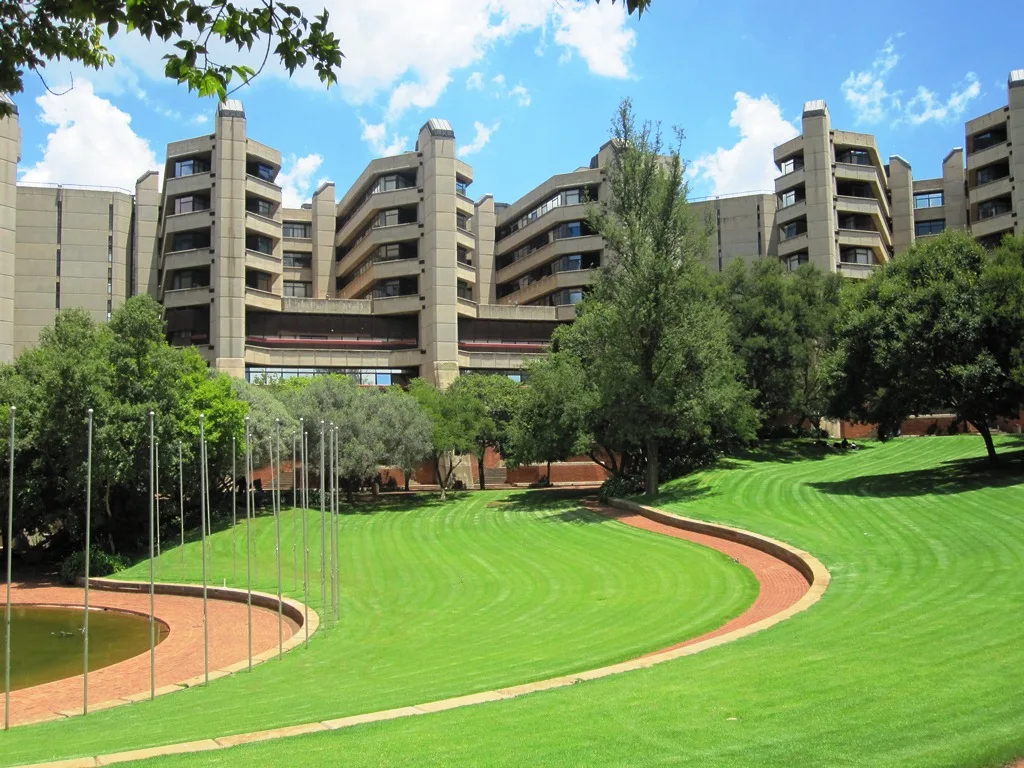
University of Johannesburg, Auckland Park - the campus whose Centre for Applied Research and Innovation in the Built Environment (CARINBE) ran this week's DiBETSA awards, not a photograph of the awards night itself. Photo: Aurobindo Ogra via Wikimedia Commons, CC BY-SA 3.0.
Four stories reached me this week, and the honest thread between them is money and attention - who gets funded, and who gets recognised. Johannesburg put twenty-three software and hardware vendors in one room to show off what digital tools can do for African infrastructure delivery. Two development banks said they are two-thirds of the way to a four-billion-dollar target. The African Union told its ministers digital infrastructure now ranks with roads and rail. And the world's biggest infrastructure-technology awards came and went again without a single African winner. Read that last one twice.
Johannesburg puts 23 digital-construction vendors in one room - and gives South Africa's AI-in-infrastructure prize a name
On Wednesday 21 October, the University of Johannesburg's Centre for Applied Research and Innovation in the Built Environment (CARINBE) and the South African Institution of Civil Engineering's Project Management and Construction Division ran DiBETSA 2026 - the Digital Built Environment Technology Showcase & Awards - at UJ's Sophiatown Residence in Auckland Park. More than 300 delegates registered for the free, CPD-accredited Technology Showcase, where 23 technology providers - Oracle, Bentley, Autodesk, Leica Geosystems, IDECO and the Industrial Digital Twin among them - demonstrated tools live, before a ticketed Awards Gala handed out prizes across four categories: Artificial Intelligence in the Built Environment, Digital Project Delivery, Energy Performance Optimisation, and Capacity Development & Technology Adoption. Oracle headlined as sponsor, alongside the Development Bank of Southern Africa, Autodesk, SACPCMP and five further industry partners. Professor Innocent Musonda, CARINBE's director and the event's keynote, put the ambition plainly: "Digital innovation is creating new opportunities to improve how infrastructure is planned, delivered and managed." An awards gala is not a mandate. But a development bank and two of the world's largest AEC software vendors sponsoring a South African university's own prize table is a different kind of signal than a press release - it is capital and vendors deciding where the continent's digital-construction talent pipeline is worth showing up for.
AfDB and the Islamic Development Bank say they're two-thirds through a $4 billion Africa target
In Jeddah this week, African Development Bank president Sidi Ould Tah met Islamic Development Bank president Muhammad Al Jasser to review progress on their 2024-2029 Cooperation Framework - a joint plan to co-finance $4 billion in sovereign and non-sovereign operations across 27 African member countries. The two banks say $2.65 billion, or 66%, is already approved, funding water, health, education, sanitation, agriculture and infrastructure projects under a January 2026 joint declaration between the AfDB Group and the Arab Coordination Group, of which the IsDB is a member. Tah used the meeting to push his own New African Financial Architecture for Development - adopted by African heads of state in Addis Ababa in February and refined into an eleven-point Abidjan Consensus in April - and asked the two institutions to stop duplicating each other's evaluation, procurement and due-diligence work. His framing of the continent's problem is the one worth remembering against Africa's own estimated $400 billion annual financing gap: "Africa does not lack resources; it lacks instruments and coordination." Coordination, not cash, is also the harder thing to put a ribbon on.
The African Union tells its ICT ministers: digital infrastructure now ranks with roads, rail and power
The African Union's Specialised Technical Committee on Communication and ICT held its ministerial session in Libreville, Gabon on 29 October, after two days of expert-level talks. AU Commissioner for Infrastructure and Energy Lerato Mataboge told ministers that digital infrastructure - cross-border fibre, regional data centres, internet exchange points, cloud capacity, last-mile connectivity - is now as essential to national development as roads, railways, ports and electricity, and called for it to be planned and financed alongside them, through dedicated financing facilities, blended finance, guarantees and public-private partnerships. Ghana's Samuel Nartey George, taking over the Committee's chair from Lesotho for the next two years, argued Africa should negotiate with the rest of the world as a market of nearly 1.5 billion people rather than 55 separate ones, pointing to Ghana's own One Million Coders Programme as the kind of domestic investment that argument needs behind it. Mataboge's own diagnosis was the sharper one: Africa "does not suffer from a shortage of digital strategies" - it suffers from a shortage of financing and institutions able to execute them.
Bentley Systems handed out its 2026 Year in Infrastructure Awards. Not one winner was African.
Bentley Systems named the twelve category winners of its 2026 Year in Infrastructure Awards in early October - its annual showcase of the most advanced digital-engineering and digital-twin projects worldwide. The winners: a metro-expansion digital twin in Portugal, a campus digital twin in India, port construction in Ireland, a pumped-storage power station in China, renewable-energy geospatial work in the Philippines, project delivery in Poland, high-speed rail design in the Czech Republic, two transport and transmission projects in Australia, a stadium roof in Indonesia, tailings-dam modelling in Brazil, and water-network digital twins in the Netherlands. A further sixteen Founders' Honors went to Colombia, the United States, Indonesia again, China again, Portugal again, Ecuador, the UK, Singapore, the United States again, Italy, Brazil again, Norway and France. Not one African country, company or project appears anywhere on either list. I am not going to manufacture an African angle this global software vendor's awards night does not have. I am going to say plainly that an industry handing out prizes for the world's best digital-infrastructure delivery, year after year, with nothing from this continent on the list, is itself the story Afro-BIM exists to change.
For decision-makers: notice where the money actually is this week - not in a single African digital-infrastructure mandate, but in two development banks reconciling a co-financing pipeline, and a university prize table that Oracle, Bentley and Autodesk thought worth sponsoring. If you run a ministry, a utility or a contractor serious about this, get your project onto a sponsor list or a winners list before the finance arrives disorganised and the awards keep going to everyone else.
For engineers: DiBETSA's four award categories are a checklist, not a showcase - AI in the built environment, digital project delivery, energy performance optimisation, and capacity and technology adoption. If your current project cannot produce a credible entry in at least one of those categories, that is the gap to close before Bentley hands out next year's awards again with nothing from this continent on the list.
- Venture Kubariho, unveiling the future with AfroBIM
Sources & further reading
- Novus Press Bulletin - "UJ and SAICE showcase innovation shaping the future of southern Africa's Built Environment at DiBETSA 2026": event date, venue, delegate numbers, vendor list, award categories, sponsors, Musonda quote
- Gazette NGR - "AfDB, IsDB deepen cooperation on $4 billion African development projects": Jeddah meeting, financing figures, NAFAD timeline, Tah quote
- African Union - "From Digital Strategies to Delivery: AU Ministers Call for Increased Investment and Faster Implementation": Libreville session date, Mataboge and Nartey George remarks, committee chair handover
- Highways Today - "Bentley's 2026 Infrastructure Awards Spotlight Digital Engineering Around the World": full winners and Founders' Honors list by country and category
- Wikimedia Commons - "University of Johannesburg" by Aurobindo Ogra, CC BY-SA 3.0: source of this bulletin's hero photograph
Note: this bulletin's hero photograph shows the University of Johannesburg's Auckland Park campus, the institution that ran DiBETSA 2026 through CARINBE - it is not a photograph of the Technology Showcase or Awards Gala itself, which was not photographed for public release at the time of writing. World news, curated and rewritten in the founder's voice for Africa's builders.