$31 Million, 14 Countries, Four Land Notices: Africa's Daily Bulletin for 22 November 2026
One Kenyan land-acquisition gazette reaches into a railway, two roads, a bridge and a water project at once. The AfDB signs a five-year, 14-country pact with France's AFD and a record Japanese loan to its own fund. Egypt's EBRD-backed desalination platform grows by $31 million. Five sourced stories.

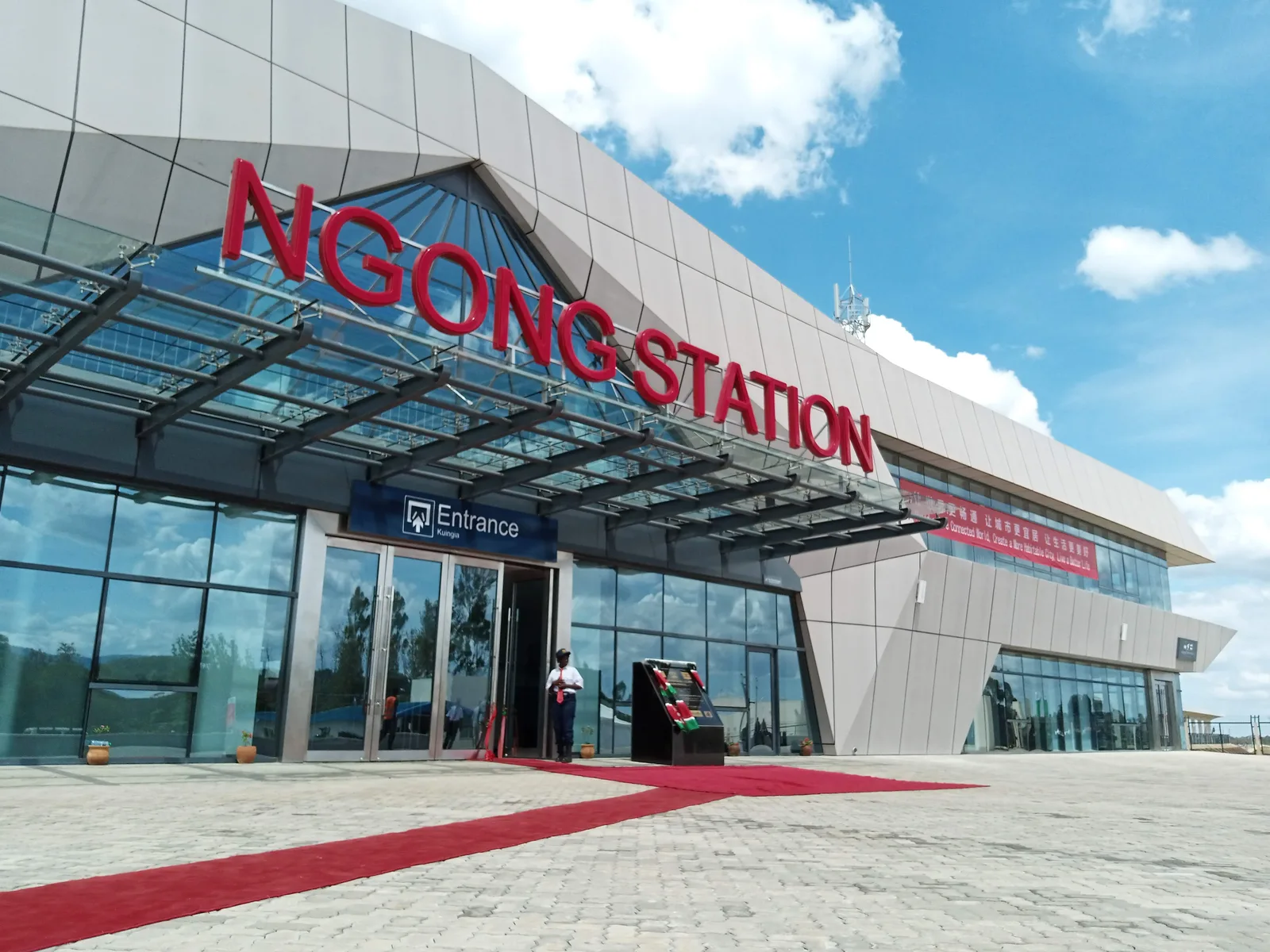
Ngong Station, on the Nairobi-Naivasha Phase 2A line, pictured on its October 2019 launch day - not this week's land-acquisition inquiry itself, but the same stretch of corridor where Kenya's National Land Commission has just gazetted two new supplementary parcels. Photo: MarkDenver Karubiu via Wikimedia Commons, CC BY-SA 4.0.
Five stories reached me this week, and not one of them is a ribbon-cutting. Kenya's land commission quietly gazetted new parcels for a railway, two roads, a bridge and a water project in the same round of notices. The African Development Bank signed a five-year financing partnership with France's AFD covering fourteen countries, then flew to Tokyo three days later for the largest single loan Japan has ever put into the Bank's own concessional fund. Egypt's biggest private desalination platform grew by $31 million, with no drought headline forcing the deal. And Bentley Systems posted another quarter of double-digit growth that its own chief executive credits to a surge in AI infrastructure spending - a surge that, so far, has not visibly reached an African address. Read all five as what they actually are: the unglamorous machinery that decides whether a project gets built, working in the background while nobody is watching.
Kenya's land commission reaches into a railway, two roads, a bridge and a water project in one gazette round
Kenya's National Land Commission gazetted a batch of supplementary land-acquisition notices on 25 September, and the inquiries they trigger are landing this month. On the Nairobi-Naivasha SGR Phase 2A line, three parcels in Kajiado County - two in Ngong, one in Kitengela - go to inquiry on 19 November at the Scheme 6 Kandisi Chief's Office. The same round covers Toku Bridge and its approach roads in Migori County (inquiry 16 November, Kitere Chief's Office, with one parcel alone running 1.1925 hectares), the Gatiiguru-Ithanga-Gakungu and Gakungu-Kamahuha-Mbombo roads in Kiambu (26 November, Kirimiri Chief's Office), and the Gatundu Water Supply and Sewerage Project, also in Kiambu (26 November, Juja Town Chief's Office). Affected landowners must bring identification, ownership records and bank details to whichever inquiry applies to them. None of this makes a groundbreaking photo. It is, nonetheless, the exact machinery - rail, road and water moving through the same bureaucratic gears in the same month - that decides whether any of these projects reaches site in the first place.
The African Development Bank signs a five-year, 14-country financing pact with France's AFD
On 10 November, on the sidelines of the Paris Peace Forum, AfDB President Sidi Ould Tah and Agence Française de Développement chief executive Christophe Lecourtier signed a memorandum of understanding covering 2026 to 2031. The two institutions say they have jointly financed 17 projects across 14 African countries since renewing their partnership in 2021 - a relationship first formalised in 2008 - with energy accounting for nearly half of that joint financing. Priorities named in the MoU include energy transition infrastructure, transport, water and sanitation, and regional connectivity, alongside critical minerals, digital infrastructure and responsible AI governance. AFD has separately committed €1 billion to Mission 300, the AfDB-World Bank push to connect 300 million sub-Saharan Africans to electricity by 2030. Named examples of the existing pipeline include 30MWp of combined Qair solar capacity in Chad and the 88MW Kakono hydropower project in Tanzania - real projects, not just a press-release figure.
Japan hands the African Development Fund its largest-ever single JICA loan
Three days after the Paris signing, in Tokyo on 13 November, Sidi Ould Tah and JICA President Tanaka Akihiko signed a ¥86,600 million loan - at 0.70% annual interest, over a 40-year term with a 10-year grace period - into the African Development Fund's Seventeenth Replenishment (ADF-17), based on replenishment talks held in London last December. It is JICA's fourth loan contribution to the Fund since ADF-14, and several outlets, including Nairametrics and the Ghana News Agency, report it at roughly $583 million and describe it as Japan's largest-ever single loan contribution to the Fund - figures I have not independently verified against a primary dollar conversion, so I am passing them on as reported rather than confirmed. What JICA's own release does confirm: the money funds ADF-17 operations through December 2028 across 37 low-income African countries, for energy access, food security, human capital, infrastructure and climate resilience, under the AfDB's Ten-Year Strategy and Japan's TICAD9 commitments.
Egypt's EBRD-backed desalination platform grows again, no drought drama needed
On 17 November, the European Bank for Reconstruction and Development announced an equity investment of up to $31 million (€28.1 million) for a 30% stake in RWD Investments, the water-development arm of Hassan Allam Utilities. HAU is contributing up to $61 million (€55.3 million) toward a total platform equity of $92 million (€83.4 million). RWD already owns and operates 79 desalination facilities across Egypt's coastal cities, with a combined design capacity of about 96,340 cubic metres a day as of December 2025; the new capital is meant to add up to 15,000 cubic metres of daily capacity each year through 2030, plus rehabilitation of existing plants to cut their energy use. "Water is a strategic resource for Egypt and essential to the country's resilience and future growth," said EBRD President Odile Renaud-Basso. Amr Allam, Hassan Allam Utilities' Group Co-CEO, called water security "a strategic priority for Egypt's long-term economic development." No emergency forced this one - it is ordinary platform growth, which is exactly the kind of water-infrastructure story that rarely gets written up.
Bentley Systems posts another quarter of double-digit growth, and credits AI infrastructure spending
Bentley Systems' third-quarter 2026 results, published 5 November, show revenue of $421.5 million, up 12.2% year-over-year, with annualised recurring revenue reaching $1,582.8 million against $1,405.2 million a year earlier - a 13% constant-currency ARR growth rate the company has now raised its full-year guidance around. CEO Nicholas Cumins said "the engineering firms we serve are benefiting from an unprecedented level of investment in infrastructure for AI," adding that nearly 70% of finalists in Bentley's own Year in Infrastructure Awards this year used AI in their submitted projects. I reported in this bulletin's 3 November edition that those same global awards have, so far, listed zero African winners. Put the two facts side by side and the pattern is plain: the infrastructure-AI investment wave Bentley's numbers describe is real and large, and not one dollar of it that Bentley has publicly named has yet landed on an African project.
For decision-makers: a land-acquisition inquiry notice is where an infrastructure project is actually contested, long before anyone breaks ground - if you have an interest in the Kajiado, Migori or Kiambu parcels named above, the inquiry date is your one formal chance to be heard, not a formality to skip. The same discipline applies to financing MoUs: a 14-country pact or a record concessional loan is only as real as the named projects behind it, so ask which ones, not just how much.
For engineers: Bentley's numbers say the money chasing "infrastructure AI" globally is real and growing fast. If your firm wants a share of it, the case has to be made in the same language the financiers above are already using - named projects, named figures, a model an independent party can review - not a slide about potential.
- Venture Kubariho, unveiling the future with AfroBIM
Sources & further reading
- Kenyans.co.ke, 26 September 2026 - National Land Commission's gazetted supplementary acquisitions for Nairobi-Naivasha SGR Phase 2A (Kajiado), Toku Bridge (Migori), Gatiiguru-Ithanga-Gakungu Road (Kiambu) and the Gatundu Water Supply and Sewerage Project (Kiambu), with each inquiry's date and venue
- Wikimedia Commons - "Ngong SGR station, 16-10-2019" by MarkDenver Karubiu, CC BY-SA 4.0: source of this bulletin's hero photograph
- Nairametrics, 12 November 2026 - AfDB-AFD five-year MoU: signing date and location, 17 projects across 14 countries since 2021, priority sectors, Mission 300 commitment, Qair Chad and Kakono Tanzania project examples
- JICA, 13 November 2026 - official release on the ¥86,600 million loan to the African Development Fund's Seventeenth Replenishment: interest rate, term, grace period, named signatories and purpose
- EBRD, 17 November 2026 - official release on the $31m equity stake in RWD Investments: stake size, HAU's co-investment, existing plant count and capacity, planned expansion, and named quotes
- Bentley Systems, 5 November 2026 - official Q3 2026 results release: revenue, ARR, guidance and the CEO's quote on infrastructure AI investment
Note: the $583 million figure attached to Japan's loan to the African Development Fund, and the description of it as Japan's largest-ever single contribution, come from secondary reporting (Nairametrics, Ghana News Agency) rather than a dollar figure I confirmed directly in JICA's own release, which states the amount in yen only; I have flagged that distinction in the text. The hero photograph shows Ngong Station on its October 2019 launch day, not this week's land-acquisition inquiry, which has no photograph of its own; the caption states this plainly. Bentley Systems' figures are the company's own reported results.