20 Scenarios, Four Deliverables, Zero Dates: Huawei And SARA's New African Rail Initiative
At SARA's 15th Rail Conference in Johannesburg on 20-22 October, Huawei and the Southern African Railways Association launched the African Intelligent Rail Initiative - a white paper, a sharing platform and a working group, three years after an MOU promised similar ground, with no funding or date attached to either.

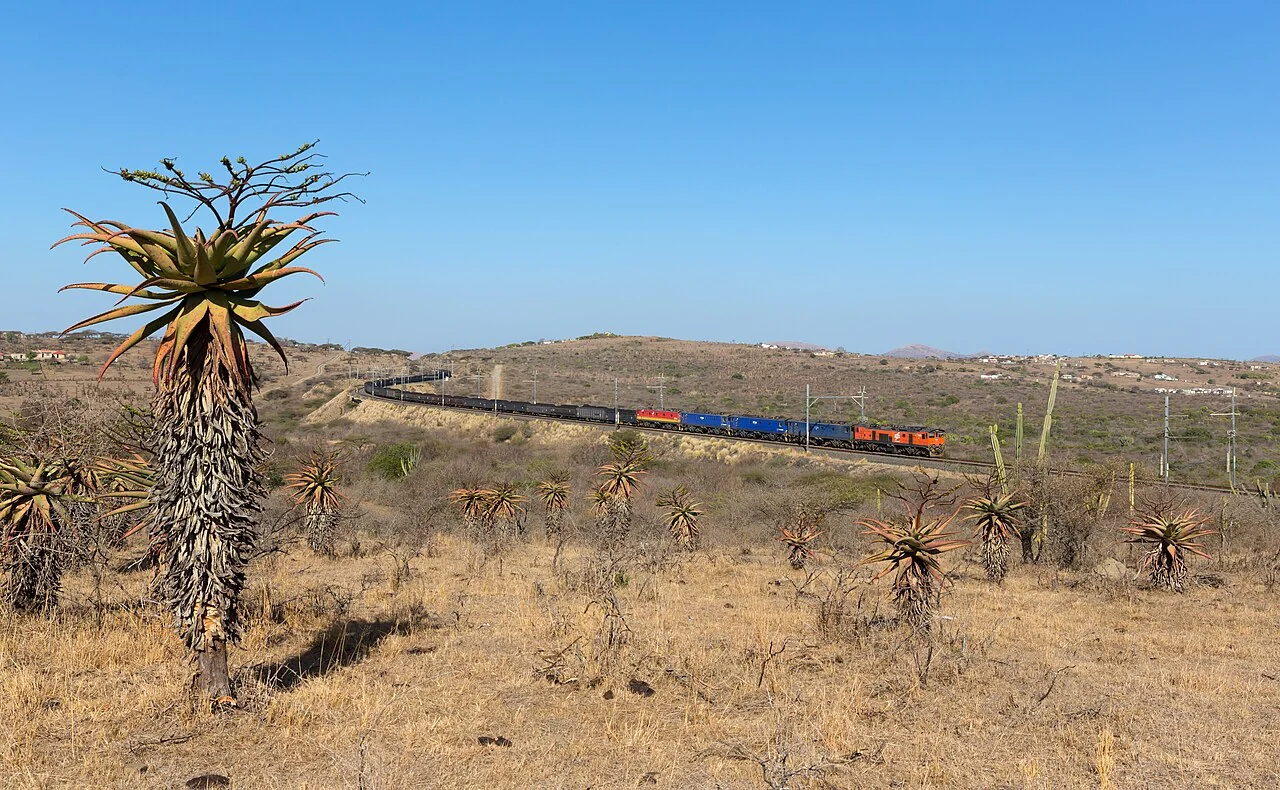
A Transnet coal train on the South African rail network - the kind of operational railway the newly-launched Huawei-SARA African Intelligent Rail Initiative wants onto one digital standard. Photo: Kabelleger / David Gubler (bahnbilder.ch) via Wikimedia Commons, CC BY-SA 3.0.
I've watched enough rail-digitalisation announcements promise a shared database and a common signalling standard to know the difference between a signed concession and a slide at a conference. On 20-22 October, at the 15th SARA Rail Conference & Exhibition in Johannesburg, Huawei and the Southern African Railways Association (SARA) launched the African Intelligent Rail Initiative (AIRI) - a regional push, coordinated by SARA, to bring railway operators, technology vendors, engineering firms and research institutions onto one digital playbook. The deliverables on the table, by my count, number four: a white paper and technical reference framework, a platform for sharing digitalisation projects, an annual best-practice recognition programme, and a joint working group. Not one of them carries a date, a budget, or a named pilot corridor.
Four deliverables, no delivery date
AIRI's stated activities are a technical reference framework and white paper on African rail digitalisation, a platform for operators to share successful digitalisation projects, an annual recognition programme for best practice, and a joint working group to carry the work forward. Huawei used the same conference to introduce Intelligent RAIL 2.0 to the Southern African market - 20 scenario-based solutions spanning railway construction, passenger and freight operations, and infrastructure and equipment maintenance, following the portfolio's global launch at InnoTrans 2026 in Berlin. Victor Guo, President of Huawei's Sub-Saharan Africa Enterprise Business, framed the problem as institutional rather than physical: "Southern Africa's railway challenges extend beyond physical infrastructure." Raymond Zuo, President of Huawei's Smart Rail Business Unit, put the solutions in more modest terms: "Our solutions are developed with industry partners to address the practical needs of railway operators." Kevin Yang, President of the Government and Enterprise Domain at Huawei's Data Communication Product Line, gave a keynote on Huawei's Stellar AI Railway Integrated Data Network Solution. A day before the conference opened, Huawei ran a technical tour of its Woodmead facility that Transnet - South Africa's state freight and rail operator, and the single biggest network AIRI would need on board - attended. SARA marked its 30th anniversary at the same gathering. No source I opened for this piece names a second operator, a specific corridor, or a rand, dollar or yuan figure attached to any of AIRI's four deliverables.
This conversation started in 2023
AIRI is not Huawei and SARA's first attempt at this. In 2023, at an earlier SARA annual conference also held in Johannesburg, the two signed a memorandum of understanding with a strikingly similar shape: a non-exclusive cooperation framework across SARA's rail corridors, a commitment to identify and recommend minimum regional ICT railway standards, work on train-control technology, access to a shared database meant to cut inefficiencies and disruption in the rail supply chain, and a push to move the region's signalling off GSM-R - whose 4 MHz of bandwidth Huawei's own reporting called too narrow for the region's needs - onto its successor, the Future Railway Mobile Communication System (FRMCS). Huawei's side of that 2023 announcement leaned on scale: 25 years operating in Africa, rail and metro customers served since 1996, its digital railway solutions deployed on more than 150,000 kilometres of track worldwide, and more than 3,000 contributions to industry standards. None of the coverage of this year's AIRI launch states whether that shared database went live, whether a minimum regional ICT standard was ever adopted, or how far the FRMCS migration has actually got in any SADC country. I'm not asserting those commitments failed - I have no source confirming either way. What I can say is that AIRI's own deliverables - a white paper, a platform, an award, a working group - sit in the same category as the 2023 MOU's: frameworks and forums, not kilometres of fibre or a signed corridor contract.
What's actually new here
Two things distinguish AIRI from a straight repeat. First, Intelligent RAIL 2.0 is a real, globally-launched product portfolio, not a framework document - it exists, Huawei is selling it, and InnoTrans 2026 gave it a public debut before Johannesburg got the regional version. Second, Transnet's attendance at the Woodmead technical tour is the closest thing in this reporting to an operator signal, even though no article names Transnet - or any other operator - as a committed AIRI participant rather than a conference guest. Everything else is coordination machinery: a working group, a white paper process, an annual award ceremony. That machinery can matter - Africa's railways do need one common reference framework instead of a dozen incompatible corridor-by-corridor ICT specs - but machinery is not delivery, and I'd rather Venture's readers track the white paper's actual publication than take a launch-event quote as the thing itself.
For decision-makers: before your operator joins AIRI's working group, ask SARA or Huawei directly what became of the 2023 MOU's shared database and "minimum regional ICT standard" commitments. A second initiative promising a white paper is not progress if the first one's promises were never publicly checked off - and you deserve to know which parts of this you're re-funding.
For engineers: watch for AIRI's technical reference framework specifically, and read it against the information-delivery standards you already work to - ISO 19650, IFC's rail extensions. "Regional ICT railway standard" is exactly the kind of commitment that turns into a common-data-environment requirement on the next signalling tender, and you want to know what's in it before it's in your contract.
- Venture Kubariho, unveiling the future with AfroBIM
Sources & further reading
- TechFinancials, 29 October 2026 - "Huawei and SARA launch new initiative to advance intelligent rail development in Southern Africa": AIRI's four planned deliverables, Intelligent RAIL 2.0 details, Victor Guo and Raymond Zuo quotes, Kevin Yang keynote, Woodmead technical tour and Transnet attendance, SARA 30th-anniversary context, AfCFTA framing
- Developing Telecoms, 2 November 2026 - "Huawei discusses digitisation of railways in Uzbekistan and Southern Africa": corroborates the 20-22 October Johannesburg launch date, AIRI's four deliverables, participant categories and AfCFTA/cross-border corridor framing
- CAJ News Africa, 2 November 2023 - on the 2023 Huawei-SARA memorandum of understanding: officials named, shared-database and minimum-ICT-standard commitments, GSM-R-to-FRMCS migration goal, Huawei's Africa-scale figures, cited here as sourced background on what AIRI follows
- Wikimedia Commons - "Transnet Freight Rail Class 7E3 Emakwezini - Isangoyana" by Kabelleger / David Gubler (bahnbilder.ch), CC BY-SA 3.0: source of this story's hero photograph
Note: no source opened for this piece discloses a funding figure, timeline or named second operator for AIRI's four planned deliverables, or confirms what became of the 2023 MOU's shared-database, minimum-ICT-standard or FRMCS-migration commitments. The hero photograph depicts a Transnet freight train in daily operation on the South African network; it is not a photograph of the AIRI launch event itself, which this research found no freely-licensed image of.