$1.2 Billion, 411 Kilometres, One Record Guarantee: Tanzania Signs Its Tabora-Kigoma Railway Financing
On 4 November, Tanzania signed a $1.2 billion commercial financing facility - part of a $2.3 billion package - for the 411-kilometre Tabora-Kigoma section of its Standard Gauge Railway, anchored by the African Development Bank's largest Partial Credit Guarantee to date.

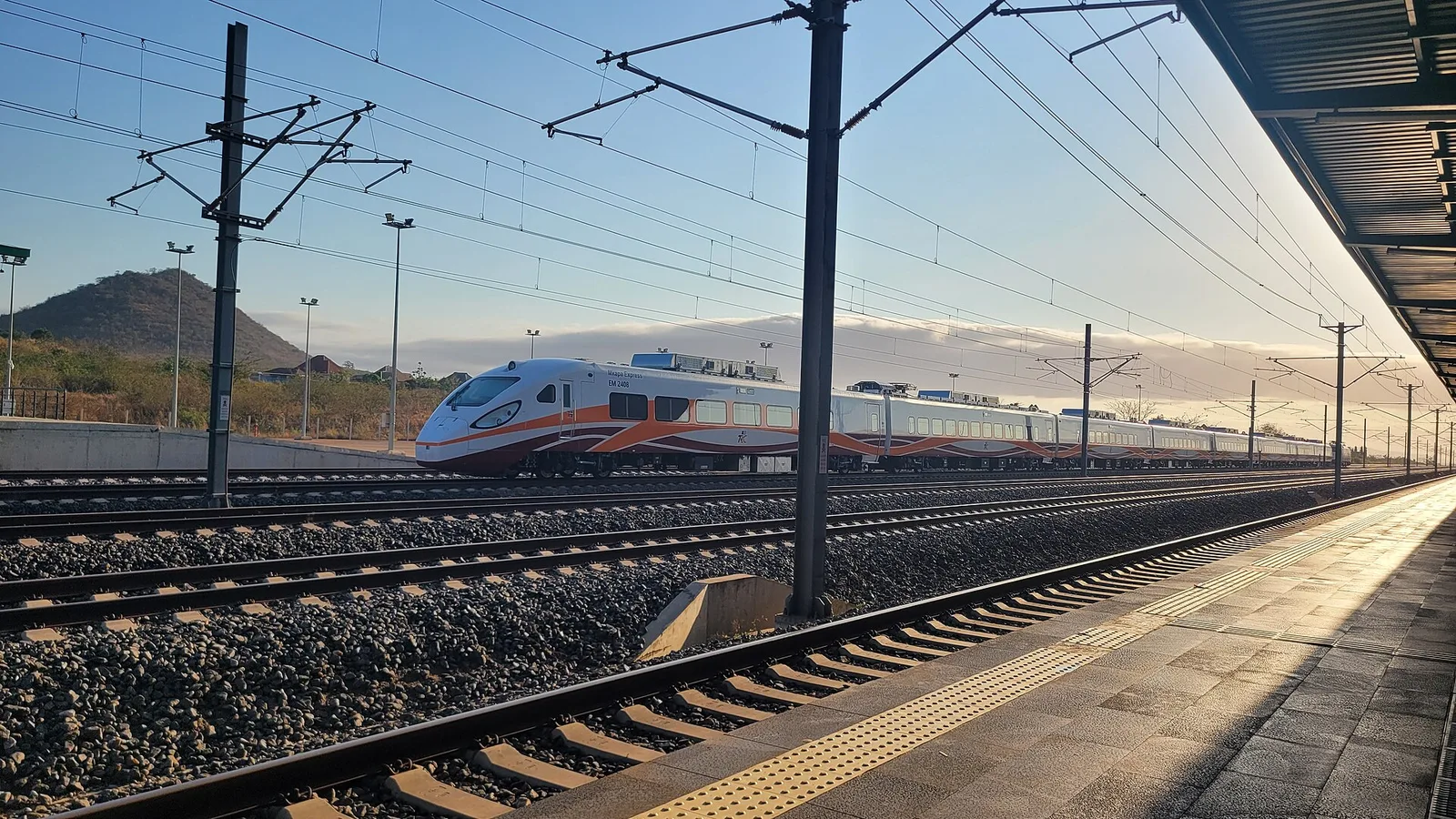
An EMU train on Tanzania's Standard Gauge Railway at Morogoro station - on the already-operational Dar es Salaam line, not the still-unbuilt Tabora-Kigoma section this financing pays for, but the same national SGR programme and the same rolling stock standard. Photo: Robert E Mawere via Wikimedia Commons, CC BY 4.0.
I've written in this series about African megaprojects that get announced twice, three times, sometimes four, before a single document gets signed. This one I can date precisely. On 4 November, the African Development Bank announced that Tanzania had signed a $1.2 billion commercial financing facility for Lot 6 of its Standard Gauge Railway - the 411-kilometre electrified line from Tabora to Kigoma, on the shore of Lake Tanganyika. The number that made me stop and read the release twice wasn't the $1.2 billion. It was the guarantee sitting underneath it: an $800 million Partial Credit Guarantee, the largest the AfDB has ever written. That is the bank telling the market, in the bluntest instrument it has, that it is willing to put more of its own balance sheet behind this railway than behind any single infrastructure deal before it on the continent.
The guarantee that makes the rest possible
Here is how the AfDB's own announcement, carried by AllAfrica on 4 November, breaks the structure down. The Bank acted as Initial Mandated Lead Arranger for the $1.2 billion commercial facility, splitting it into $720 million of guaranteed lending - the portion the Partial Credit Guarantee covers, principal plus two years of interest - and $480 million lent against Tanzania's clean sovereign risk, with no guarantee attached. Nine commercial banks make up the syndicate: Deutsche Bank and Société Générale as co-arrangers, joined by HSBC, Commerzbank, Nedbank, Stanbic Bank Tanzania, First Abu Dhabi Bank, FirstBank UK and Bank of Africa UK. A separate layer of credit insurance, arranged through broker Texel, spreads $405.5 million of that exposure across a panel of international insurers including Lloyd's syndicates. None of that is cheap to assemble, and that is precisely the point: a guarantee this large is the AfDB underwriting the project's credibility to nine banks and a panel of insurers who would not otherwise touch a 411km railway through Tanzania's interior on Tanzania's balance sheet alone.
The $1.2 billion is not the whole railway's financing - it is part of a $2.3 billion package for Lot 6 that also includes an export credit agency tranche and a further tranche still to be mobilised with a co-guarantor, neither of which the 4 November announcement puts a number or a date on. Tanzania has separately mandated the AfDB to structure and mobilise up to $3.2 billion for its wider regional railway development ambitions, of which this facility is the first piece actually signed. Mike Salawou, the AfDB's Director for Infrastructure and Urban Development, put the ambition in his own words: "Our ambition is to translate this landmark financing into a corridor that supports competitive industries." Max Ndiaye, the Bank's Senior Director overseeing the deal, described the approach as combining development finance, commercial lending and insurance capacity to reach a scale no single instrument could manage alone.
Two years from coordination letter to signature
This financing has a paper trail I could actually follow, which is rarer than it should be in this series. In December 2024, at the African Investment Forum's Market Days in Rabat, the AfDB signed a coordination letter with Deutsche Bank and Société Générale committing to structure a syndication strategy to mobilise up to $1.2 billion for the SGR. Ndiaye called it then "a significant milestone not only for Tanzania but for Africa's integrated economic future." Myriam Ouazzani, Deutsche Bank's Managing Director for Africa, said the bank was "excited to be part of this landmark project," and Société Générale's Randolph Fotso was credited with brokering the agreement from the French side. Almost two years later, that coordination letter has become a signed facility with a guarantee, nine lenders and an insurance panel attached. For a continent where "financing approved" and "financing disbursed" are routinely years and sometimes projects apart, watching one deal actually walk that distance, on the record, with the same institutions and the same official named at both ends, is worth noting on its own.
What this signs, and what it doesn't
Here's where I have to be the engineer, not the cheerleader. This is a financing close, not a construction update. I found no figure in this announcement, or in the coordination-letter coverage from 2024, for how much of the Tabora-Kigoma line is physically built, what contractor is laying track, or when trains are meant to run - those are separate facts I have not verified for this piece and will not guess at. Nor does the 4 November announcement say anything about digital delivery: no mention of a BIM-managed design, a common data environment, or reality capture on the alignment, and I did not find a source confirming any of those tools are specified for this contract. What I can say, as an engineer who has sat on the other side of African infrastructure financing, is this: a guarantee structure this large - insurers, an export credit tranche still to come, a sovereign-risk layer banks priced separately from the guaranteed layer - does not get built on hope. It gets built on a model of the asset and its risks that lenders and insurers can actually interrogate line by line. Whether that model lives in a spreadsheet or a federated BIM environment is not something this announcement discloses, and until Tanzania Railways Corporation or the AfDB says otherwise, I am not going to assume the more advanced version just because the number attached to the deal is large.
For decision-makers: a $2.3 billion package with $1.1 billion still unmobilised (the ECA tranche and the co-guarantor layer) is a financing structure, not a finished deal. If you sit on the Tanzanian or regional side of this corridor, the open question worth tracking is who structures those remaining tranches and on what timeline - that is where the next real news on this railway will come from, not from the part already signed.
For engineers: a $800 million guarantee on 411km of railway is nine banks and an insurance panel asking, in effect, "show us the asset model." Whether Tanzania Railways Corporation and its contractors answer that with a shared digital model or a stack of static drawings is not disclosed here - but it is exactly the kind of question I'd want on the table before the next tranche is priced, because lenders who guarantee at this scale eventually ask for the data behind the number.
- Venture Kubariho, unveiling the future with AfroBIM
Sources & further reading
- AllAfrica, 4 November 2026 - African Development Bank announcement on the $1.2 billion Tabora-Kigoma commercial facility: the $800 million Partial Credit Guarantee, the nine-bank syndicate, the $405.5 million insurance layer, and quotes from Mike Salawou and Max Ndiaye
- The Citizen (Tanzania), 12 December 2024 - "AfDB, Deutsche Bank, French bank to mobilize $1.2 billion for Tanzania SGR": the original coordination letter signed at the African Investment Forum in Rabat, with quotes from Max Ndiaye and Myriam Ouazzani
- Wikimedia Commons - "EMU Train of Tanzania" by Robert E Mawere, CC BY 4.0: source of this story's hero photograph
Note: this piece reports a signed financing facility, not a construction-progress update - no source opened for this piece states how much of the Tabora-Kigoma line is physically built, names a construction contractor, or gives a completion date, and none discloses whether BIM, a common data environment or reality capture is specified for the project; those are separate claims this piece does not make. The $2.3 billion total package figure and the $3.2 billion wider mandate come from the AfDB's own 4 November announcement and are not independently verified beyond that release. The hero photograph depicts an EMU train on Tanzania's operational Dar es Salaam SGR line, not the Tabora-Kigoma section itself, which has no freely-licensed photograph available at time of publication.